Product design

TEVIMBRA is a unique PD-1 inhibitor, optimally designed for robust T-cell activation, with potential for synergistic combination1-5

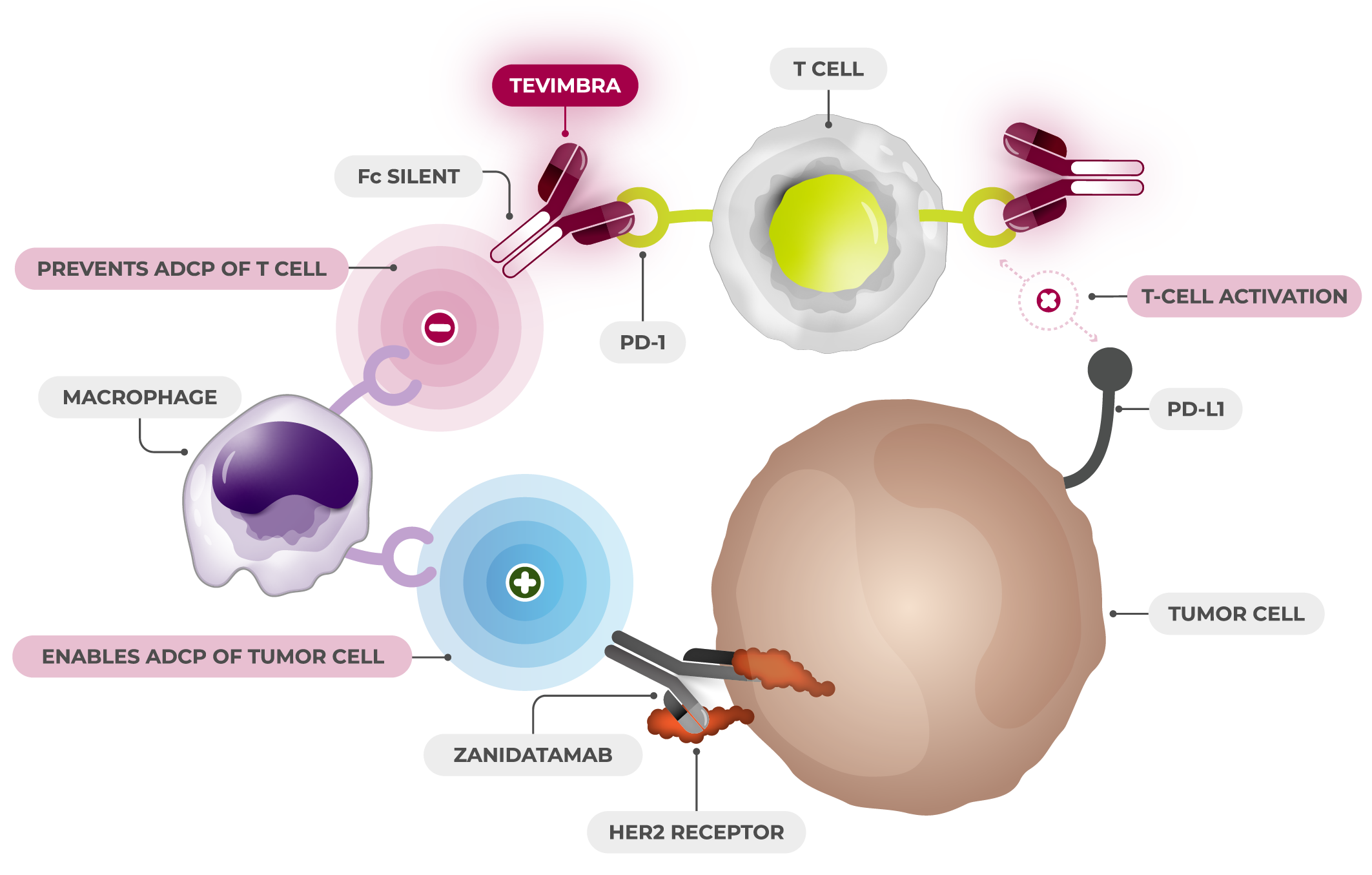
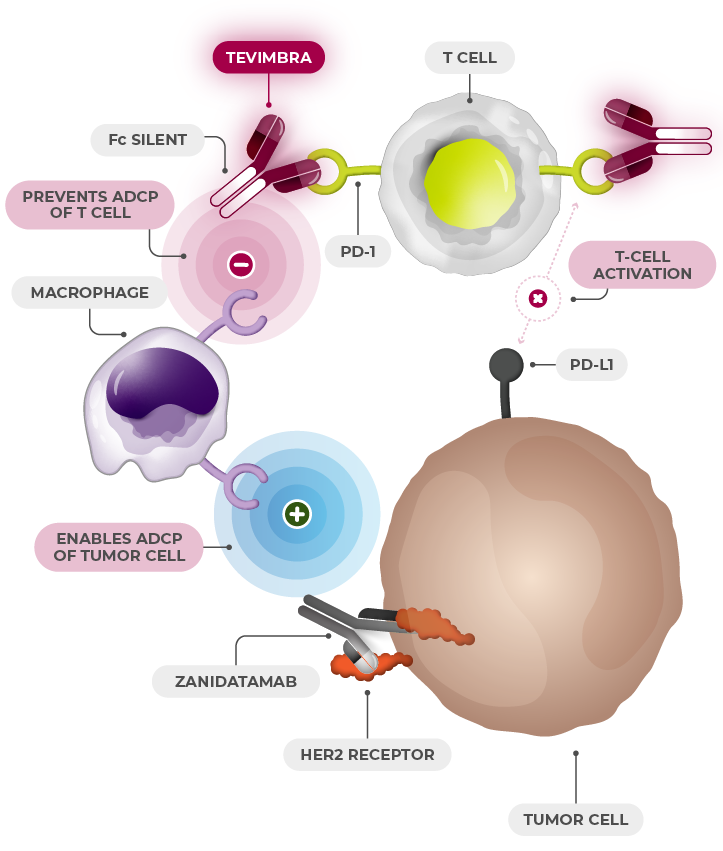
TEVIMBRA is designed to increase T-cell activation

TEVIMBRA features a unique Fc-silent region, which minimizes binding to FcγR on macrophages and can increase the concentration of activated T cells.2,3

See what makes TEVIMBRA different in this short video:

Clinical significance of preclinical data has not been established.

TEVIMBRA may work synergistically with zanidatamab, a dual HER2-targeting agent1,4

Zanidatamab is not a T-cell engager. It is a bispecific antibody with dual HER2-targeted binding properties.

Zanidatamab binding to HER2 can result in:

  • internalization and HER2 reduction
  • induction of ADCC, ADCP, and CDC
  • targeted tumor cell death
TEVIMBRA® t-cell activation diagram
Clinical significance of preclinical data has not been established.

.

An Expert in Oncology Explains TEVIMBRA's Mechanism of Action

Ronan J. Kelly, MD, MBA, discusses how TEVIMBRA is a unique PD-1 inhibitor.

Frequently Asked Questions

Expand All
TEVIMBRA is a unique PD-1 inhibitor, optimally designed for robust T-cell activation with potential for synergistic combination. TEVIMBRA was specifically engineered to increase the number of activated T cells by preventing its binding to FcγR on macrophages, thereby preventing T-cell clearance.2,3

TEVIMBRA may work synergistically with zanidatamab, a dual HER2-targeting agent. Zanidatamab is not a T-cell engager. It is a bispecific antibody with dual HER2-targeted binding properties. Zanidatamab binding to HER2 can result in internalization and HER2 reduction, targeted tumor cell death, and induction of ADCC, ADCP, and CDC.1,4

1L, first line; ADCC, antibody-dependent cellular cytotoxicity; ADCP, antibody-dependent cellular phagocytosis; CDC, complement-dependent cytotoxicity; ESCC, esophageal squamous cell carcinoma; Fc, crytallizable fragment; FcγR, Fc gamma receptor; GC, gastric cancer; GEA, gastroesophageal adenocarcinoma; GEJC, gastroesophageal junction cancer; GI, gastrointestinal; PD-1, programmed death receptor 1; PD-L1, programmed death ligand 1.
References: 1. Shitara K, Elimova E, Liu T, et al. N Engl J Med. 2026;394(20):2002-2014. doi:10.1056/NEJMoa2517729 2. Zhang T, Song X, Xu L, et al. Cancer Immunol Immunother. 2018;67(7):1079-1090. doi:10.1007/s00262-018-2160-x 3. Zhang L, Geng Z, Hao B, Geng Q. Cancer Control. 2022;29:10732748221111296. doi:(7)10.1177/10732748221111296 4. Ziihera. Prescribing Information. Jazz Pharmaceuticals, Inc.; 2026. 5. Tabernero J, Shen L, Elimova E, et al. Future Oncol. 2022;18(29):3255-3266. doi:10.2217/fon-2022-0595.

You are being redirected to nccn.org

This site is intended for US healthcare professionals only. Please confirm you are a US healthcare professional.

You are being redirected to myBeOneSupport.com